
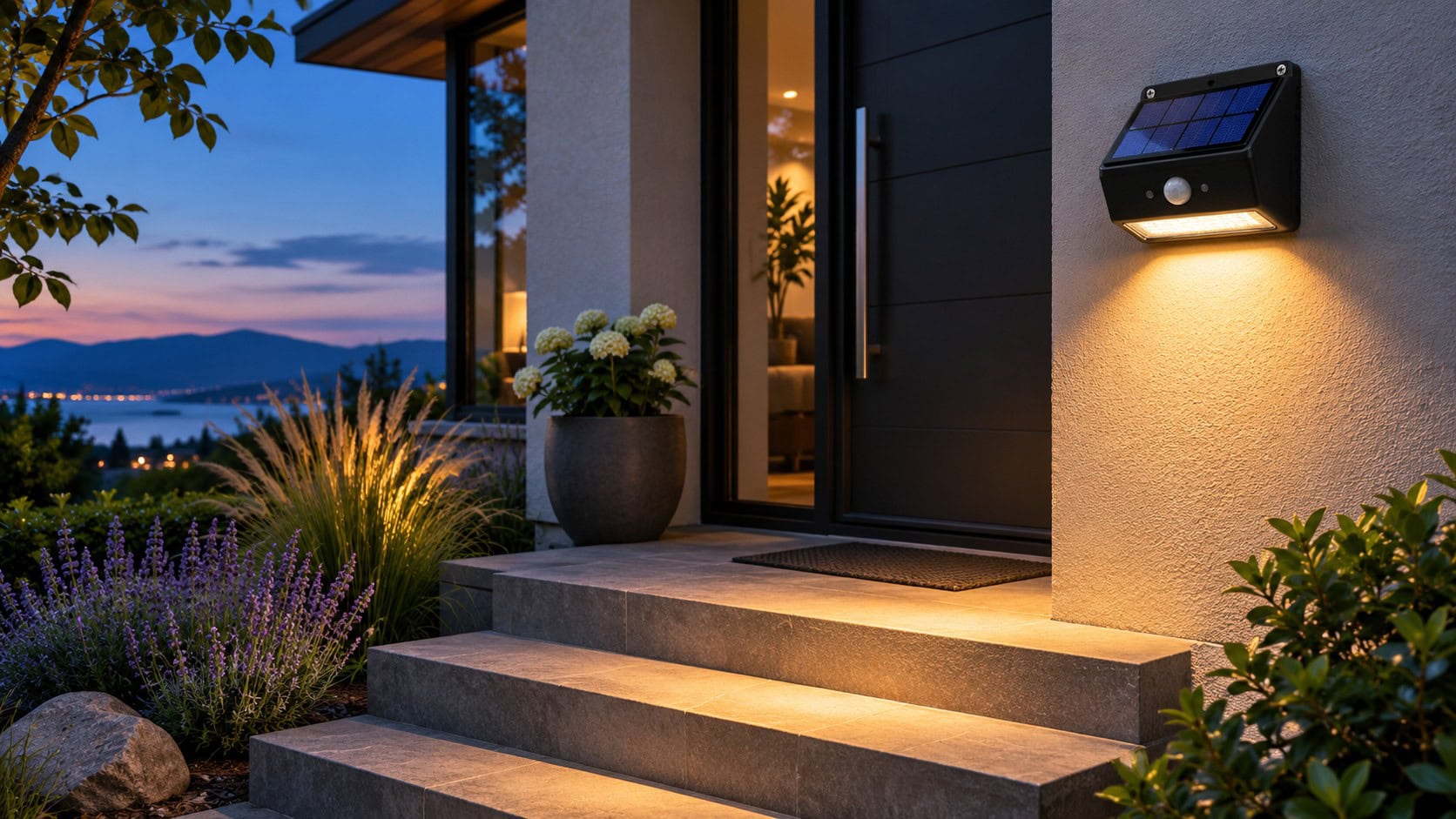
A solar motion sensor wall light needs to do three jobs at the same location. Its panel must receive enough daylight to recharge, its sensor must detect people as they approach, and its beam must reach the steps, lock, or walkway they need to see. Check those three points at the intended mounting position before choosing a fixture.
Start with the Approach Route
Stand where the light will be mounted and look at how people actually enter the space. At a front door, you may need light on the first step and the lock. At a side gate, the sensor should detect someone before they reach the latch. Along a driveway, useful coverage often requires aiming the beam away from drivers and neighboring windows.
Many solar wall lights use a passive infrared (PIR) sensor. Detection can vary with the mounting height, the direction of movement, and the temperature difference between a person and the surroundings. A person walking across the detection zone is often easier to detect than someone walking straight toward the sensor. Ask for the detection diagram at the intended mounting height, then walk the real approach route after dark.
Compare the Three Common Lighting Modes
| Lighting mode | What happens after dark | Best fit |
|---|---|---|
| Motion only | The light stays off until it detects motion. It switches off after the hold time. | Side gates and storage areas used occasionally |
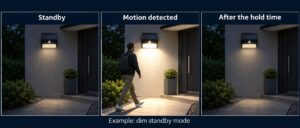
| Dim standby with motion boost | The light stays dim, brightens when it detects motion, and returns to dim after the hold time. | Entrances that need a low level of light between visits |
| Steady light | The light stays on at the selected output for the supported operating period. | Short paths or areas that need continuous visibility for a defined period |
Ask what happens when the sensor detects movement again during the hold time. A light that restarts the timer with every detection may stay bright much longer at a busy entrance. That can be helpful for visibility, but it increases battery use. Dim standby also draws power between visits, so compare runtime in the mode you plan to use.
Check Whether the Panel and Light Can Share a Location
An integrated solar wall light works well when the mounting spot receives enough daylight and gives the lamp a clear view of both the approach route and the area to be lit. It also keeps the installation compact.
A split-panel solar wall light
gives you more flexibility under a deep eave or on a shaded wall. Mount the panel in a sunnier spot and aim the light where it is needed. Before ordering, check whether the supplied cable can reach along the actual route and whether the panel, cable connector, and light each have suitable protection for their installed locations.
Check shade at different times of day. A wall that looks sunny at noon can still receive limited daylight across the charging window, especially in winter.
Read the Specs Before Comparing Samples
| Specification | What to ask the supplier |
|---|---|
| Light output and coverage | Request rated lumens and a beam diagram or nighttime photos at a stated mounting height. For steps, check whether the light reaches the tread edges. |
| PIR detection | Ask for the detection angle, range, recommended mounting height, and hold time. Test both a side approach and a straight-on approach. |
| Battery and runtime | Ask for battery voltage and capacity, the test mode, thestarting charge, and the number of motion activations used in the runtime test. |
| Solar charging | Check panel wattage, orientation guidance, and expected charging conditions. For split-panel models, confirm the cable length. |
| Outdoor protection | Confirm the IP rating of each exposed component and any mounting conditions specified by the supplier. IEC 60529 |
Aim the beam at the steps, door, or path and use the lowest brightness that provides useful visibility. Where the application allows, choose warm light and limit how long the fixture stays at full output. DarkSky and IES outdoor lighting principles
Test the Sampl
e Where It Will Be Used
For a retail or private-label order, test a sample after it has charged in the intended location. Walk the approach from each likely direction, check whether the light comes on early enough, and time how long it stays bright after you leave. Run the preferred mode over several nights and record the charging conditions and approximate number of activations. This gives you a better basis for comparing samples and deciding what runtime to state on the packaging.
If you are requesting a q
uote, share the installation location, mounting height, preferred lighting mode, expected nightly traffic, and target market. These details help narrow the choice between an integrated fixture and a split-panel model. For larger areas that need broader coverage, see our solar flood light guide.
Frequently Asked Questions
Why does my solar wall light come on too late?
The approach m
ay be at the edge of the sensor’s detection zone, or people may be walking directly toward the sensor. Test the actual route and check the fixture’s mounting height and orientation against the supplier’s detection diagram.
Can I install a solar motion light under a covered porch?
Yes, if the panel still receives enough daylight. If the porch shades the panel for much of the day, choose a split-panel model and place the panel where it receives more sun.
How should I compare two lights that both claim eight hours of runtime?
Ask which mode was used, whether the test started with a full battery, and how often motion triggered the light. Those conditions determine whether the two runtime figures describe comparable use.