
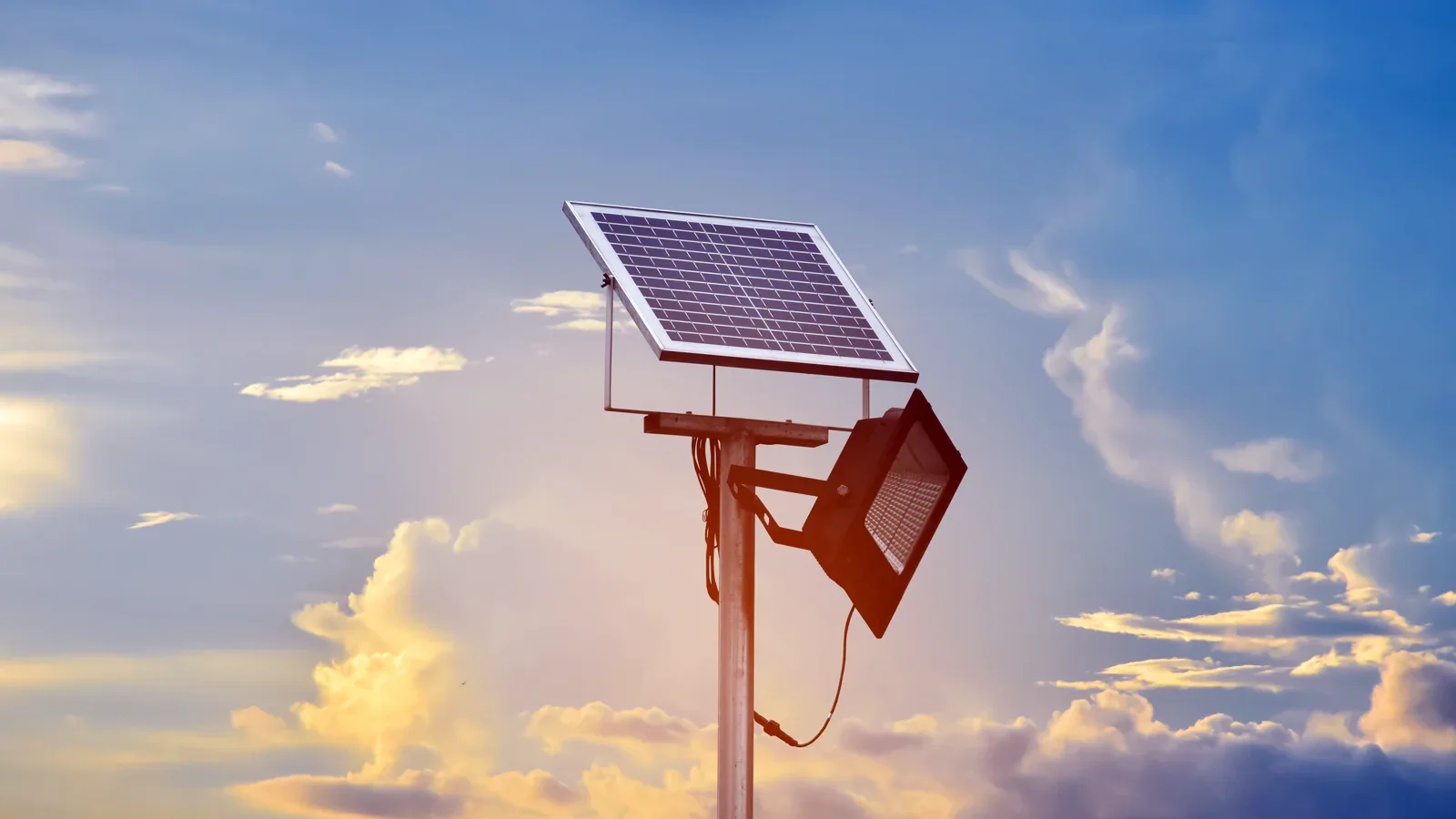
Solar flood lights are not chosen by a wattage claim. You need balanced output, storage, charging, controls, protection, and installation. This guide shows what to compare before buying or developing a product.
How Solar Flood Lights Work
A solar flood light is a small off-grid energy system. The panel collects daytime energy, the controller manages charging, the battery stores power, and the LED converts that power into useful light.
The U.S. Department of Energy says solar area lighting suits sites where grid connection is difficult or demand is low or intermittent. Adequate local solar energy and correct sizing still determine performance.
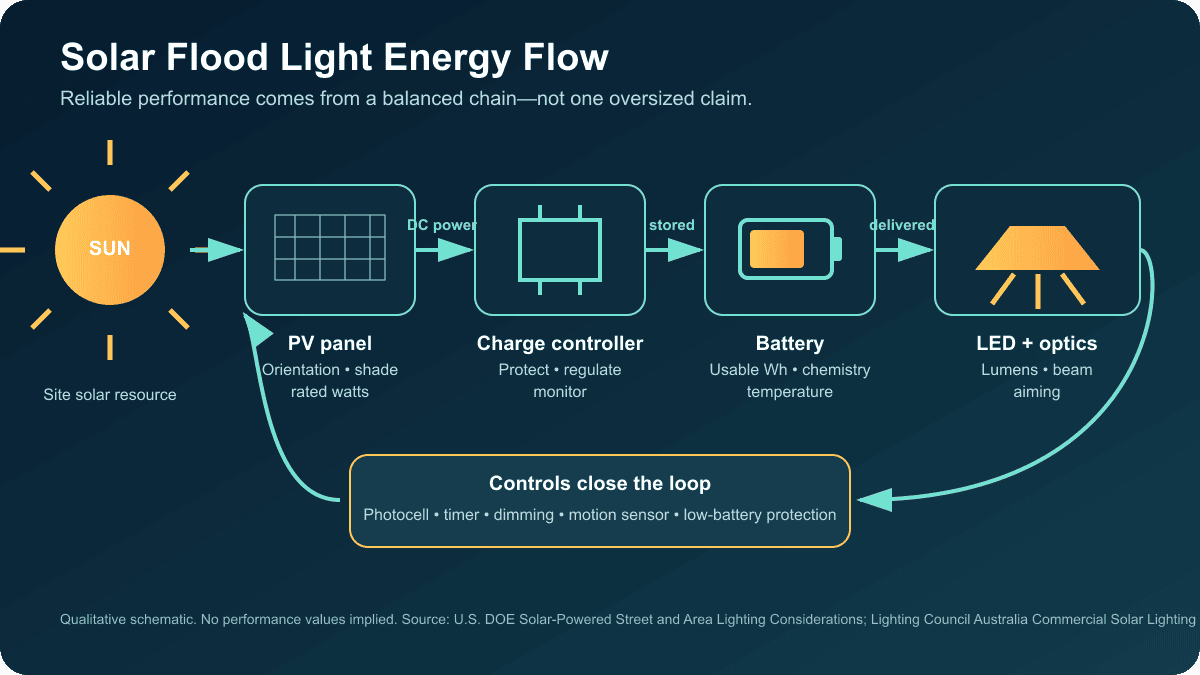
Solar flood light energy flow. Source: original schematic based on the U.S. Department of Energy solar area-lighting factsheet and Lighting Council Australia guidance.
Read the Specifications as a System
One impressive number cannot guarantee useful light after several cloudy days. Compare the complete specification and ask for evidence behind every important claim.
| Specification | What it tells you | What to request |
| Light output | Lumens describe total emitted light, not where it lands. | Rated lumens, efficacy, beam angle, and a photometric file or test report. |
| Illuminance | Lux shows how much light reaches a surface. | A layout based on mounting height, spacing, aiming, and the target area. |
| Battery | Watt-hours help compare usable stored energy. | Chemistry, voltage, capacity, permitted depth of discharge, and temperature limits. |
| Solar panel | Rated watts indicate charging potential under defined conditions. | Panel wattage, orientation requirements, and the worst-month sizing basis. |
| Controls | The operating schedule determines daily energy demand. | Dusk-to-dawn, timed dimming, motion sensing, and low-battery behavior. |
| Enclosure | The IP code classifies protection against solid objects and water. | An IP claim supported by testing to IEC 60529, plus application-specific corrosion or UV evidence. |
Do not compare batteries by mAh alone. Because watt-hours equal voltage multiplied by amp-hours, identical mAh ratings can store different energy at different voltages.
Integrated or Split Solar Flood Light?
The right architecture depends on where sunlight falls and where light is needed. A compact product is convenient, while a separate panel gives you more freedom.
| Design | Main advantage | Trade-off | Best fit |
| Integrated | Fewer parts and a cleaner, faster installation. | The panel and luminaire must share one mounting position. | Open, sunny locations with a suitable lighting angle. |
| Split | The panel can face the sun while the light targets a shaded area. | More cabling, connections, brackets, and installation checks. | Eaves, gates, signs, loading areas, and irregular sites. |
Match the Product to the Application
Start with the job, not a marketplace listing. A side gate, driveway, warehouse perimeter, and temporary work area need different beam control, runtime, sensing, and mounting.
- Gate or side passage:prioritize controlled aiming, motion response, and a clear detection zone.
- Driveway or yard:balance beam width, mounting height, glare control, and the intended lit hours.
- Commercial perimeter:request a lighting layout, defined control profile, serviceable components, and project-specific autonomy.
- Sign or façade:verify panel placement separately from the lighting angle and prevent spill beyond the target.
Responsible outdoor lighting should be useful, targeted, no brighter than necessary, controlled, and warm-colored where possible. These principles from DarkSky and the Illuminating Engineering Society improve comfort and reduce wasted light.
Size for the Worst Month, Not the Best Day
Solar products often look strongest after ideal summer charging. Reliable design begins with the lowest expected solar resource, the required night schedule, and realistic system losses.
- Define the target area, required illuminance, uniformity, mounting height, and beam direction.
- Write the nightly control profile, including full output, dimmed periods, and motion events.
- Estimate daily energy demand from LED power and operating time, then include controller and battery losses.
- Size the panel for local worst-month peak sun hours, orientation, shade, temperature, dirt, and aging.
- Size usable battery energy for the required autonomy while respecting chemistry and depth-of-discharge limits.
- Validate the complete system through charging, runtime, photometric, environmental, and aging tests.
Lighting Council Australia recommends checking the lowest expected solar insolation, panel orientation, degradation allowances, battery chemistry, depth of discharge, and autonomy. Professional project design is preferable when lighting levels or safety obligations are critical.
Avoid These Common Buying Mistakes
- Choosing by “equivalent watts” or LED count:neither proves delivered lumens, beam quality, or runtime.
- Ignoring panel shade:a bright luminaire cannot compensate for energy the panel never collected.
- Accepting mAh without voltage:you cannot compare stored energy accurately without watt-hours.
- Assuming an IP label proves durability:request the test basis and consider seals, drainage, UV exposure, corrosion, and cable entries.
- Specifying full brightness all night:unnecessary output increases battery and panel requirements; use controls where appropriate.
- Skipping service planning:confirm how the battery, controller, sensor, and seals can be inspected or replaced.
What OEM and ODM Buyers Should Specify
A strong request for quotation gives the manufacturer measurable targets. It also prevents late changes after the housing, battery compartment, optics, and tooling are already fixed.
| RFQ section | Include these decisions |
| Application | Country, site type, target area, mounting height, operating season, and user scenario. |
| Optical | Target lumens or lux, beam distribution, color temperature, color rendering, glare limits, and aiming. |
| Energy | Night schedule, autonomy target, panel configuration, battery chemistry, usable Wh, and charging protections. |
| Mechanical | Integrated or split design, housing materials, bracket range, fasteners, seals, cable length, and service access. |
| Controls | Photocell logic, motion behavior, dimming profile, remote functions, and low-power fallback. |
| Verification | Photometric, ingress, charging, runtime, thermal, environmental, aging, inspection, and traceability requirements. |
| Commercial | Forecast volume, packaging, labeling, documentation, sample stages, delivery market, and compliance responsibilities. |
FAQs about Solar Flood Lights
How long do solar flood lights stay on?
Runtime depends on usable battery energy, LED power, control mode, charging conditions, temperature, and battery age. Ask for a defined test condition instead of accepting an isolated hour claim.
Do solar flood lights work on cloudy days or in winter?
They can, but available solar energy is lower. Reliable designs use local worst-month conditions, suitable panel placement, energy-efficient controls, and enough battery autonomy for the intended application.
Is IP65 always enough for outdoor use?
Not automatically. The correct IP classification depends on exposure, while coastal corrosion, UV, heat, cold, mounting, and maintenance create additional requirements beyond the enclosure code.
Are motion-sensor or dusk-to-dawn lights better?
Motion control suits intermittent access and can reduce energy demand. Dusk-to-dawn operation supports continuous visibility but requires more daily energy. A dimmed baseline with motion boost can balance both goals.
Can solar flood lights be customized for private-label programs?
Yes. Typical development decisions include optics, housing, controls, battery and panel matching, mounting, appearance, packaging, and test plans. Confirm every option against your target market and application.
Build Your Solar Flood Light Program with Us
With nearly 20 years of LED lighting and precision manufacturing experience, we provide integrated OEM and ODM support from product development and core-component manufacturing to lamp assembly, testing, and global delivery.
Our 18,000+ m² facility combines precision engineering, flexible customization, quality control, and efficient production. Explore our solar flood light solutions or contact us to discuss your market, performance targets, and project timeline.