
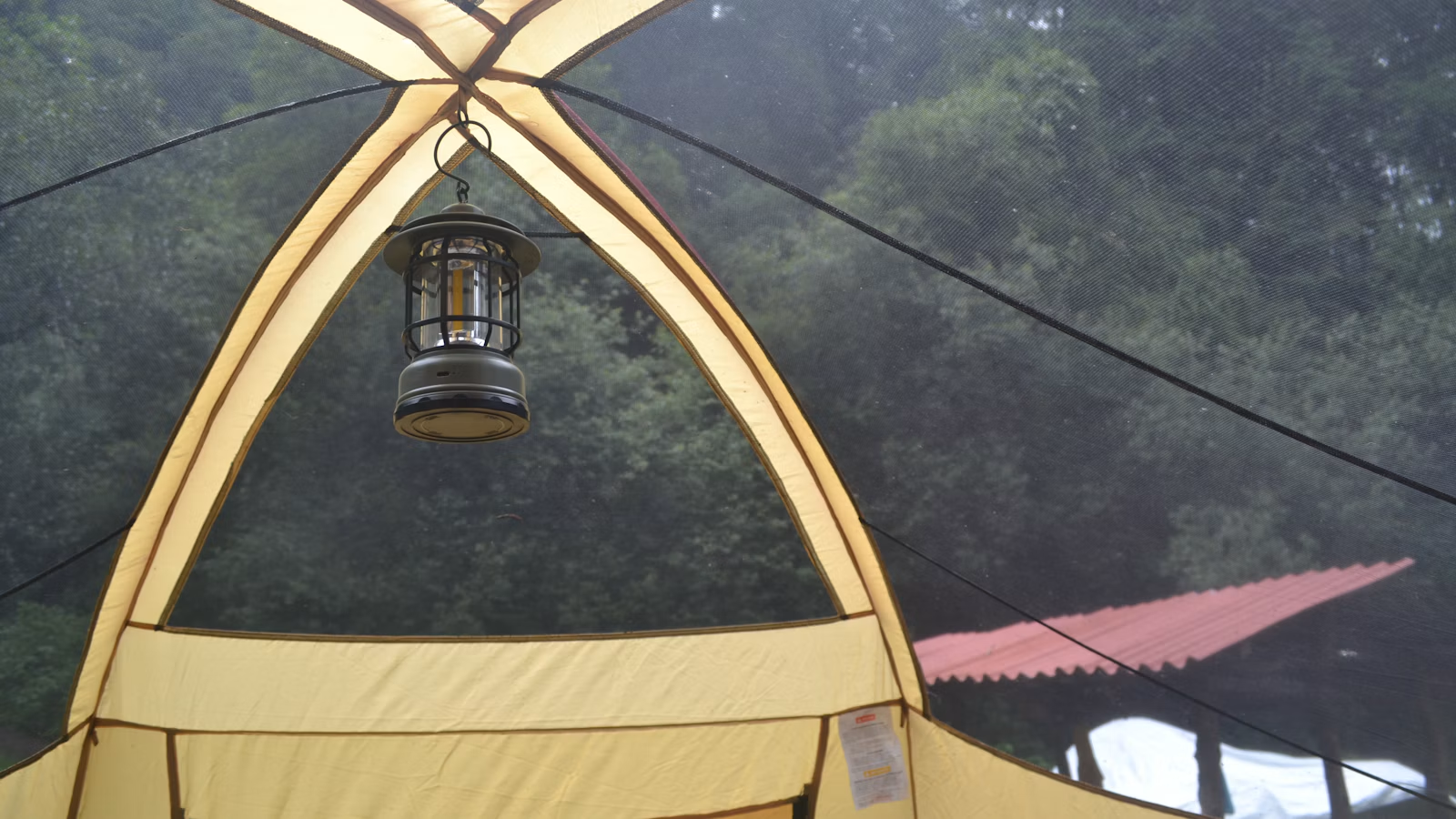
The best solar camping lights balance useful brightness, comfortable diffusion, realistic charging, battery capacity, and packability. Choose for your actual trip—not the largest lumen claim—and treat solar charging as part of a complete power plan.
Why Solar Camping Lights Need Balance
A solar camping light combines a photovoltaic panel, charge controller, rechargeable battery, LED source, optics, housing, and user controls. Each part affects the next.
A large battery is not helpful if the panel cannot replenish it. High brightness is not useful if glare makes a tent uncomfortable or quickly consumes the stored energy.
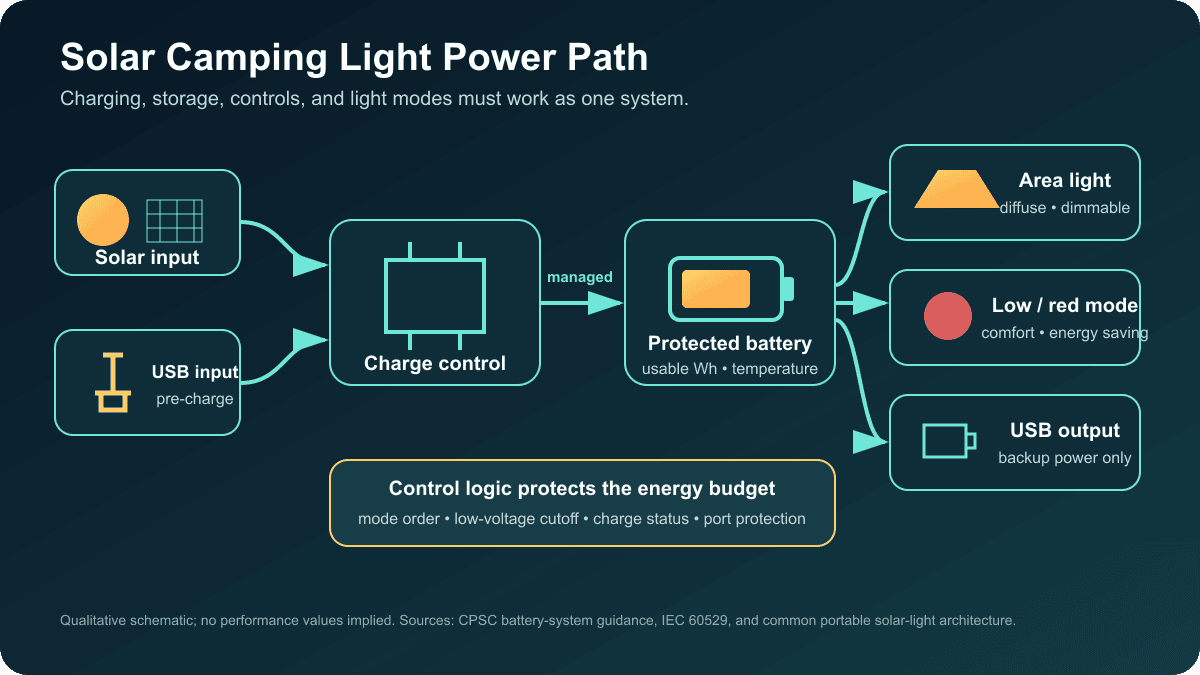
Energy and control path inside a solar camping light. Source: original qualitative schematic informed by CPSC battery-system guidance, IEC enclosure guidance, and common camping-light architecture; no performance values are implied.
Look for a product that explains both sides of the equation: how energy enters the battery and how each lighting mode uses that energy.
Choose the Right Camping Light Format
Your campsite determines the best form factor. Backpackers value packed size, while car campers can carry a larger lantern with stronger controls and more battery capacity.
| Format | Main strength | Watch for | Typical use |
| Collapsible lantern | Compact storage and soft area light. | Hinge, seam, diffuser, and repeated-fold durability. | Backpacking, tents, and emergency bags. |
| Fixed lantern | Stable body, accessible controls, and room for a larger battery. | Weight, packed volume, and handle comfort. | Car camping, tables, and group camps. |
| String light | Spreads low-level light across a wider social area. | Cable storage, attachment points, and setup time. | Awnings, shelters, vans, and picnic areas. |
| Lantern-flashlight hybrid | Combines diffuse area lighting with a directional beam. | Control complexity and accidental mode changes. | General camping and vehicle emergency kits. |
| Light with power output | Can share stored energy with a small device. | Phone charging reduces lighting runtime. | Backup use when a dedicated power bank is unavailable. |
Read the Specifications That Matter
Product listings often lead with maximum lumens. That number describes total light output, but it does not explain runtime, diffusion, low-mode usefulness, or charging recovery.
| Specification | Useful question | Evidence to request |
| Lumens and modes | Is the light comfortable for cooking, reading, walking, and relaxing? | Output for every mode, dimming behavior, beam pattern, and test method. |
| Runtime | How long does each useful mode remain usable? | Runtime curves or defined start, end, temperature, and brightness conditions. |
| Battery energy | How much energy is actually stored? | Voltage, amp-hours, watt-hours, chemistry, protection, and cycle-test basis. |
| Solar input | How much direct sun is needed to restore useful runtime? | Panel rating, orientation instructions, and charging tests under stated conditions. |
| USB input and output | Can you pre-charge reliably and share power when necessary? | Connector type, input/output ratings, protections, and compatible charging instructions. |
| Weather resistance | Can the enclosure handle the intended rain, dust, and handling? | Tested IP classification under IEC 60529, not an unsupported marketing label. |
| Portability | Will it fit your packing and hanging system? | Weight, packed dimensions, deployed dimensions, and attachment details. |
Compare batteries in watt-hours, not mAh alone. Watt-hours account for voltage, so they provide a more meaningful energy comparison between different electrical designs.
Plan Solar and USB Charging Together
A small built-in panel receives limited solar energy. Clouds, shade, panel angle, temperature, dirt, and short days can all slow recovery.
- Fully charge the light by its approved USB method before leaving home.
- Place the panel in direct sun without shading the active surface.
- Use the lowest comfortable mode instead of running maximum output unnecessarily.
- Reserve battery energy for essential tasks before using power-bank output.
- Carry a separate backup light when illumination is safety-critical.
The U.S. Consumer Product Safety Commission says batteries, products, and chargers should be tested as a system. Follow the supplied charging instructions and stop using damaged, swollen, overheating, or leaking equipment.
For OEM programs, document cell selection, protection circuits, charging limits, wiring, port sealing, thermal behavior, assembly controls, and the applicable market requirements. Review current CPSC battery guidance with your compliance team.
Make Camp Lighting More Comfortable
Useful camp lighting is rarely the brightest possible light. Diffusion, placement, color, and easy low-mode access often matter more after your immediate task is finished.
- Hang diffuse light above a table instead of aiming a harsh beam into people’s eyes.
- Use a directional beam for walking or inspection, then switch it off.
- Choose a low or warm mode for conversation and a brighter mode for cooking or setup.
- Check whether emergency flashing can be skipped during normal mode changes.
- Keep controls easy to find by touch when the campsite is dark.
DarkSky and the Illuminating Engineering Society recommend useful, targeted, low-level, controlled, warm-colored outdoor lighting. Those principles translate naturally to considerate campsite use.
Build a Clear OEM or ODM Brief
A precise development brief helps align the optical, electrical, mechanical, packaging, and testing teams before tooling or sample production begins.
- User and trip:backpacking, car camping, family use, emergency kit, or multi-day off-grid travel.
- Light experience:area light, directional beam, color temperature, dimming, red mode, and control sequence.
- Energy system:required runtime profile, battery Wh, solar input, USB input/output, and protection logic.
- Mechanical design:target weight, packed size, hanging points, drop exposure, seals, and service strategy.
- Verification:photometric, charging, discharge, temperature, ingress, drop, aging, and transport tests.
- Commercial details:forecast volume, branding, packaging, manuals, destination markets, and inspection plan.
Ask the supplier to connect every visible claim to a specification, test condition, or controlled inspection. This makes samples easier to compare and production easier to audit.
FAQs about Solar Camping Lights
Can a solar camping light charge fully in one day?
It depends on panel size, battery energy, sunlight, angle, temperature, and starting charge. Check a test under stated conditions rather than assuming every sunny day produces a full charge.
How many lumens do you need for camping?
There is no universal target. Close-up tent lighting needs less output than cooking, group setup, or pathfinding. Adjustable modes and good diffusion are more useful than one extreme maximum.
Are solar camping lanterns waterproof?
Only when the specific model has appropriate, verified protection. Check its tested IP classification, port covers, charging instructions, and limits before exposing it to rain or splashes.
Can the lantern charge your phone?
Some designs provide USB output, but the phone draws energy that would otherwise power the light. Compare usable watt-hours and output ratings, and treat this feature as backup power.
Should you choose solar-only or dual charging?
Dual solar and USB charging is usually more flexible. USB supports reliable pre-trip charging, while the solar panel can extend off-grid use when conditions are suitable.
Develop Solar Camping Lights with Us
With nearly 20 years of LED lighting and precision manufacturing experience, we support integrated OEM and ODM development, core-component manufacturing, complete-lamp assembly, testing, and global delivery.
Our 18,000+ m² facility combines precision engineering, flexible customization, quality control, and efficient production. Explore our solar camping light solutions, learn more about us, or contact us to discuss your product brief.