

A good table lamp fits its surface, hides glare, supports the intended task, and feels easy to use. Start with function and placement, then compare light quality, proportions, controls, materials, and power type.
Start with the Table Lamp’s Job
A table lamp is both a light source and a visible object. Its best size, shade, output, and controls depend on what you expect it to do.
| Primary job | Prioritize | Check in the room |
| Ambient lighting | Soft diffusion, warm appearance, and dimming. | Does the lamp add a comfortable layer without becoming a bright hotspot? |
| Reading | Useful illumination, controlled glare, and an appropriate shade opening. | Does light reach the page while the source remains hidden from your normal position? |
| Bedside use | Reachable controls, low-mode comfort, compact footprint, and safe cord routing. | Can you operate it naturally without stretching or seeing the bare light source? |
| Accent lighting | Form, finish, shade texture, and a controlled pool of light. | Does it balance nearby art, furniture, or accessories without crowding them? |
| Portable lighting | Rechargeable battery, useful runtime, charging method, stability, and carrying comfort. | Will you actually move it, or would a plug-in lamp be simpler? |
Measure the Surface and Sightline
Product photos can hide scale. Measure the table’s width, depth, and height, then consider the user’s seated or reclining eye line before selecting a lamp.
- Footprint:leave practical space for books, a drink, a phone, or bedside items.
- Overall height:relate the lamp to both the table and nearby seating or bed height.
- Shade position:keep the bright source and internal hardware out of your usual sightline.
- Shade width:avoid a top-heavy look or a shade that dominates a narrow surface.
- Stability:check base weight, contact area, cable pull, and resistance to everyday knocks.
For matching bedside table lamps, measure both sides. Small differences in nightstand height, mattress position, or wall clearance can change how a pair looks and performs.
Compare Light Quality, Not Watts Alone
Watts describe power use, while lumens describe emitted light. Neither alone tells you how the shade distributes light or how comfortable the lamp feels.
| Specification | What it affects | What to verify |
| Lumens | Total light output. | Output at each mode and whether it suits ambient or task use. |
| Light distribution | Where the light lands. | Upward, downward, sideways, and through-shade transmission. |
| Correlated color temperature | Whether white light appears warmer or cooler. | Rated CCT, tolerance, and consistency between paired lamps. |
| Color rendering | How naturally surface colors appear. | Declared test method and relevant color-quality metrics. |
| Dimming | Adaptability between task and evening use. | Lowest useful level, transition smoothness, memory, and flicker behavior. |
The U.S. Department of Energy’s consumer lighting guide explains lumens and Kelvin-based light appearance. Use those metrics as a starting point, then evaluate the complete lamp and shade together.
Understand the Whole Product System
A dependable table lamp is more than a decorative shell. Optical, thermal, electrical, mechanical, and user-interface decisions must work together.
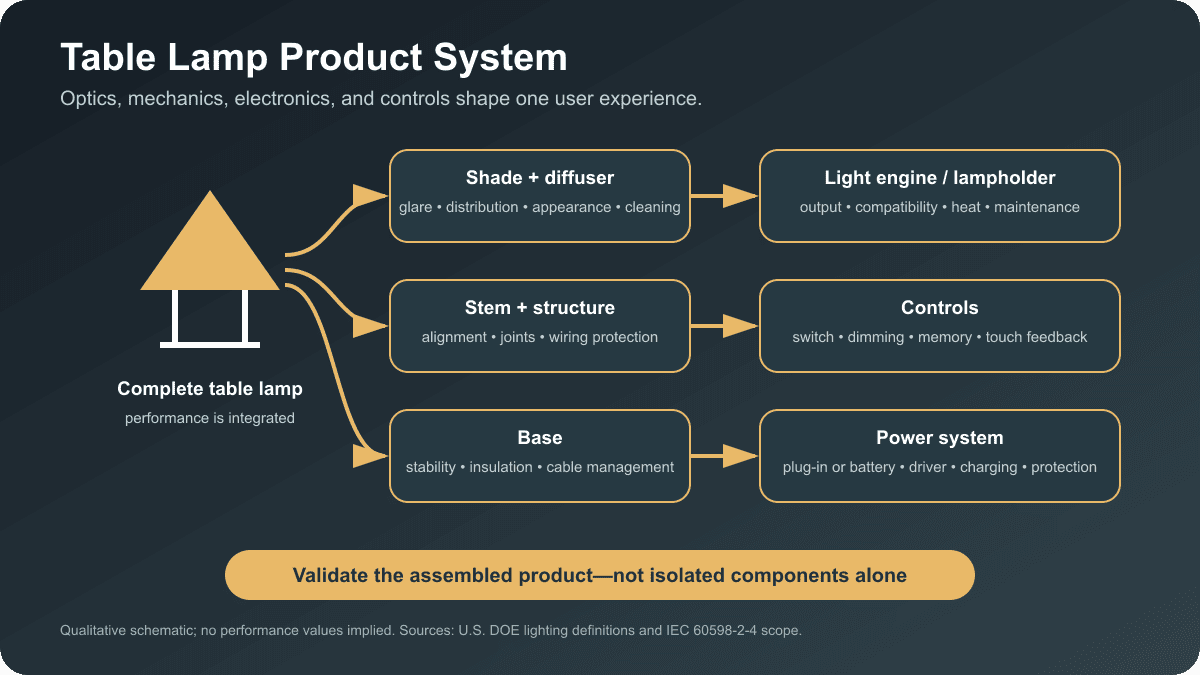
Table lamp product system. Source: original qualitative schematic informed by DOE lighting definitions and IEC portable-luminaire scope; no performance values are implied.
- Shade and diffuser:control glare, light spread, transmission, appearance, and access for cleaning.
- Light engine or lampholder:determines output, replaceability, compatibility, heat, and maintenance.
- Structure:keeps the lamp aligned and protects wiring through joints, stems, and moving parts.
- Controls:should be visible or easy to find by touch, with a logical dimming sequence.
- Base and power:provide stability, insulation, strain relief, charging, and cable management.
IEC 60598-2-4 covers portable general-purpose luminaires for indoor or outdoor use. The applicable standards and market requirements should be confirmed for each design and destination.
Plug-In or Rechargeable Table Lamp?
Choose cordless because the lamp needs to move or no safe outlet is available—not simply because rechargeable products are fashionable.
| Decision | Plug-in table lamp | Rechargeable table lamp |
| Best location | Fixed position near a suitable outlet. | Dining tables, shelves, temporary layouts, and movable accent lighting. |
| Runtime | Continuous while powered. | Depends on usable battery energy and selected brightness. |
| Maintenance | Inspect cord, plug, switch, and replaceable light source where applicable. | Also manage charging, battery aging, storage state, and replacement strategy. |
| Specification focus | Input rating, cord, plug, lampholder or driver, stability, and temperature. | Battery Wh, protection, charge time, mode runtime, USB input, and thermal behavior. |
For cordless table lamps, compare runtime at the brightness you will actually use. Maximum runtime commonly represents a low mode and cannot describe task-light performance by itself.
The U.S. Consumer Product Safety Commission advises treating the battery, product, and charger as a complete system. Review current battery safety guidance and applicable destination-market requirements during development.
Prepare a Better OEM or ODM Brief
A clear product brief prevents styling decisions from conflicting with optics, stability, assembly, charging, or compliance later in development.
- Use case:bedside, living room, hospitality, restaurant, desk-adjacent, accent, or portable use.
- Dimensions:overall envelope, footprint, shade, weight target, center of gravity, and packaging limits.
- Lighting:output, distribution, CCT, color quality, dimming range, glare control, and consistency.
- Electrical:plug-in or rechargeable architecture, input, driver, battery, charging, protections, and controls.
- Materials:base, stem, diffuser, shade, coatings, fasteners, decorative finish, and cleaning expectations.
- Verification:photometric, electrical safety, temperature, stability, endurance, ingress, drop, aging, and inspection tests.
- Commercial:volume forecast, branding, packaging, manuals, destination markets, and quality checkpoints.
Ask for samples that represent the proposed construction. A beautiful appearance sample cannot validate production light quality, battery runtime, thermal behavior, or assembly repeatability.
FAQs about Table Lamps
How tall should a table lamp be?
There is no universal height. Match the lamp to its table, nearby furniture, and user sightline. The shade should hide the source while directing light where needed.
Which shade gives the softest light?
Light-colored translucent materials usually spread more light than dark or opaque shades. Shape, lining, openings, diffuser design, and the source position also change the result.
Is a table lamp suitable for reading?
Yes, when it delivers sufficient light onto the page without visible glare. Placement, shade geometry, output, and dimming matter more than the decorative style alone.
Are rechargeable table lamps worth it?
They are useful when portability or outlet-free placement solves a real problem. For a permanent position near an outlet, plug-in power may be simpler.
Can an indoor table lamp be used outside?
Only if the specific lamp is designed and rated for that exposure. Indoor construction should not be assumed to resist rain, condensation, dust, or outdoor temperature changes.
Develop Your Table Lamp Collection with Us
With nearly 20 years of LED lighting and precision manufacturing experience, we support integrated OEM and ODM development, core-component manufacturing, complete-lamp assembly, testing, and global delivery.
Our 18,000+ m² facility combines precision engineering, flexible customization, quality control, and efficient production. Explore our table lamp solutions, learn more about us, or contact us with your product brief.